Aesthetic eyelid surgery · Zagreb & Daruvar, Croatia

Blepharoplasty — a fresh, rested look that lasts

Blepharoplasty is the surgical correction of the upper and/or lower eyelids, removing excess skin and fat pads. At Poliklinika Maletić, the procedure is performed under local anaesthesia using a radiofrequency knife, with an individual plan for every patient.

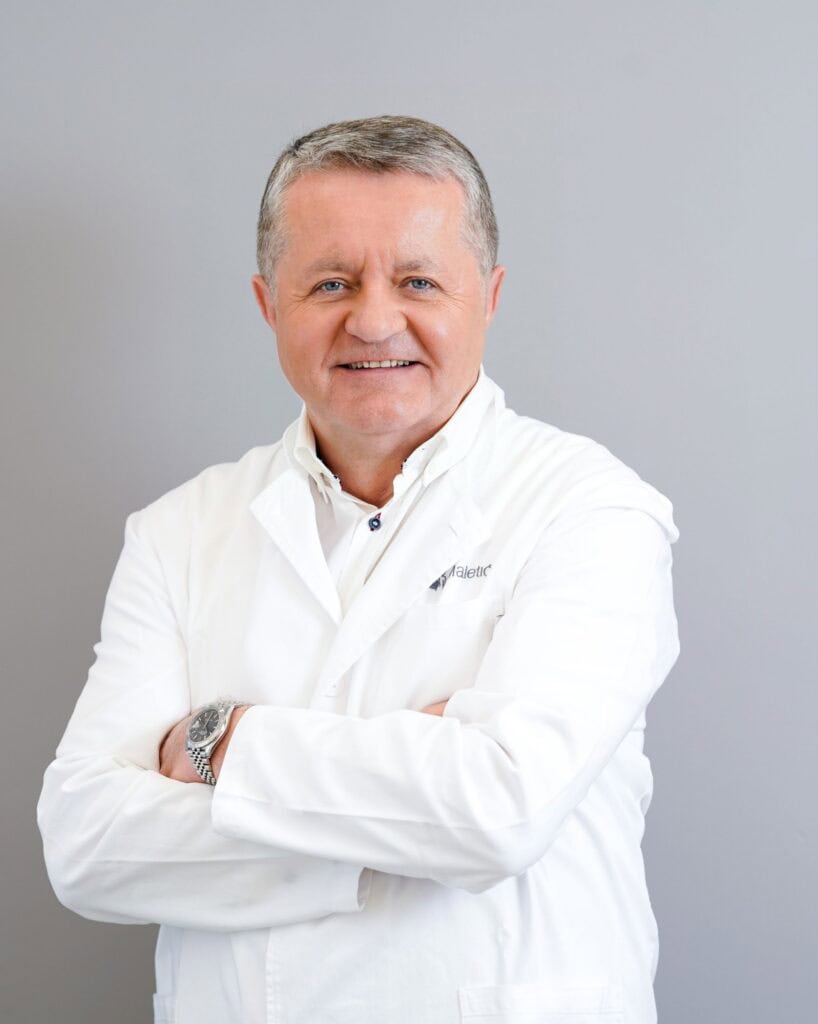
Dr. Duško Maletić

Dr. Duško Maletić — Poliklinika Maletić

Anaesthesia
Local
(sedation or general on request)
Duration
45–120 min
Recovery
8–10 days
Sutures
Dissolvable
Scars
Minimally visible
Final result
After 2–3 months
Longevity
Long-lasting,
often lifelong
About the procedure

What is blepharoplasty and when is it the right solution for you?

Blepharoplasty is a surgical procedure that removes excess skin, lax muscle and fat pads from the upper or lower eyelids. It is performed under local anaesthesia and takes 45–120 minutes, depending on the extent. The result is a more open, rested look, and the effect is long-lasting — for most patients, lifelong.

With age, eyelid skin loses elasticity, muscles weaken and fat pads become visible. The eyes start to look tired, older and heavy — and no longer reflect how you actually feel.

The procedure can be aesthetic (removal of excess skin and fatty tissue) or functional — when drooping eyelids begin to obstruct the field of vision. Poliklinika Maletić treats both indications.

The incision is placed in the natural eyelid crease, just below the lash line or on the inner surface of the eyelid. After healing, the crease conceals the scar, making it practically invisible.

The operation is performed with a precise radiofrequency knife — an instrument that cuts and seals blood vessels at the same time. This reduces scarring and speeds up recovery.

The wound is closed with dissolvable sutures — stitches that break down on their own. Dissolvable sutures mean no stitch removal and no extra visit just for that.

Did you know? Blepharoplasty is not only about aesthetics. If excess upper eyelid skin extends over the edge of the eye, it can narrow the field of vision — in that case the procedure is medically indicated.
Types of procedure

Upper and lower blepharoplasty — what is the difference?

Poliklinika Maletić performs upper, lower and combined blepharoplasty. Which one is right for you is determined by the surgeon during your consultation.

Upper eyelids · 45–60 min

Upper blepharoplasty

Upper blepharoplasty is one of the most common procedures in aesthetic surgery. The incision follows the natural crease of the upper eyelid, so after healing the scar is hidden and almost invisible. Excess skin — and fat pads where needed — is removed.

It is suitable for people who:

  • have upper eyelid skin that droops or folds over the edge of the eye
  • look tired or older for no apparent reason
  • experience forehead tension because the muscles constantly try to lift the eyelids
  • have a narrowed field of vision due to excess skin
Lower eyelids · 60–90 min

Lower blepharoplasty

Even if you have been covering dark circles with concealer for years and creams have not delivered — bags under the eyes are usually fat pads that no cream can remove.

The approach can be transconjunctival (an incision on the inside of the eyelid, with no external scar) or an incision just below the lower lash line. Fat pads are removed or repositioned, and excess skin is reduced.

It is suitable for people who:

  • have under-eye bags that are always visible, regardless of sleep
  • have a lower eyelid that looks lax or puffy
  • have dark circles that respond neither to creams nor to rest
  • have developed excess skin in the lower eyelid area

Upper vs. lower blepharoplasty at a glance:

Upper blepharoplastyLower blepharoplasty
Incision placementNatural crease of the upper eyelidInside the eyelid (transconjunctival) or below the lash line
What is correctedExcess skin, fat pads where neededFat pads (bags), excess skin
Duration45–60 minutes60–90 minutes
ScarHidden in the crease, almost invisibleNo external scar, or minimally visible
Most common reasonTired look, narrowed field of visionPersistent bags and dark circles

Can upper and lower blepharoplasty be performed at the same time?

Yes — combined blepharoplasty is performed in a single procedure and takes about 2 hours. Recovery is not significantly longer, and the result is a comprehensive transformation of the eye area.

Whether it can be combined with a brow lift or facelift is assessed individually by Poliklinika Maletić during your consultation.

Are you a candidate?

Who are the ideal candidates for blepharoplasty?

Blepharoplasty is suitable for:

  • people with excess upper eyelid skin that creates a tired or older appearance
  • people whose excess upper eyelid skin is starting to obstruct their field of vision
  • people with under-eye bags that persist no matter how rested they are
  • people with lax skin on the lower eyelids
  • younger people with a hereditary tendency to excess eyelid skin — the procedure is not reserved for older age
  • anyone who wants a refreshed, more rested look without visible traces of intervention
When is blepharoplasty not recommended?

We assess each case carefully in the presence of pronounced dry eye, Graves' disease (thyroid orbitopathy — an autoimmune thyroid disorder affecting the eyes) and certain blood-clotting disorders.

All contraindications are established by Poliklinika Maletić during the examination and consultation — before any decision about surgery is made.

Not sure whether you are a candidate? Book a free consultation — the examination does not commit you to surgery.

Before the procedure

Preparing for blepharoplasty — what should you know?

In most cases the procedure requires no special preoperative preparation. Here is what matters:

  • During the consultation, the surgeon assesses in detail the excess skin, tissue elasticity, brow position and fat pads — and proposes the optimal correction plan.
  • Be sure to inform the doctor about any medication you take — especially anticoagulants (blood thinners) such as Aspirin, Andol, Warfarin or Heparin — and about your general health.
  • If you take blood-thinning medication, the doctor will advise whether to pause it briefly or replace it with another medicine.
  • If general anaesthesia is planned, an anaesthesiologist's examination, laboratory tests and, if needed, additional work-up are required.
  • For local anaesthesia, fasting is not necessary.
Step by step

What does blepharoplasty surgery look like?

  1. 1

    Preparation and marking

    The surgeon precisely marks the incision lines, tailored to each patient's anatomy. There is no universal template — every incision is planned individually according to eye shape, brow position and the amount of excess skin.

  2. 2

    Anaesthesia

    The procedure is performed under local anaesthesia and is completely painless. At the patient's request, sedation for full relaxation or general anaesthesia is available.

  3. 3

    Surgery with a radiofrequency knife

    Poliklinika Maletić uses a radiofrequency knife that cuts and coagulates (seals) tissue at the same time. This means less bleeding, less postoperative swelling and bruising, faster healing and a superior cosmetic result compared with a conventional scalpel.

    Fat pads are removed or repositioned, excess skin is reduced, and muscles are corrected where needed.

  4. 4

    Wound closure with dissolvable sutures

    The wound is closed with dissolvable sutures that break down on their own — no stitch removal is needed.

  5. 5

    Going home

    After a short observation period, the patient goes home — the same day.

After the procedure

Recovery after blepharoplasty — what to expect?

Recovery is generally quick and predictable. Here is what a typical recovery timeline looks like:

PeriodWhat to expect
Days 1–3Rest, cold compresses, head elevated. Swelling and bruising are normal and gradually subside.
Days 4–7Swelling recedes. You can go out — any bruising is easily covered with sunglasses.
Days 8–10Return to everyday activities and make-up. Most traces are no longer visible.
2–3 monthsFinal result — the skin has stabilised, scars fade, and the eyes look fresh and natural.

Have a question about recovery in your specific case? Ask the surgeon at your free consultation.

Why choose us

Why do patients choose Poliklinika Maletić for blepharoplasty?

Finally — a surgeon who plans every incision around the anatomy of your eye, not around a template.

Radiofrequency knife — not a conventional scalpel

The radiofrequency knife cuts and coagulates tissue at the same time. The result: less bleeding, less postoperative swelling, faster healing and a better cosmetic outcome.

Dissolvable sutures

The sutures break down on their own — no stitch removal and no extra visit just for that.

An individual approach, not a template

Every incision is marked according to the individual patient's anatomy — eye shape, brow position, skin elasticity. No two procedures are identical.

A family clinic since 1998

More than 25 years of experience in facial aesthetic surgery. Personal attention, continuity and trust built over decades.

Two locations — Zagreb and Daruvar

Patients choose the location that suits them better. The same surgeon, the same standard of care.

Free, no-obligation consultation

We examine your eyelids, discuss what bothers you and what you want to achieve — and give you an honest recommendation. The decision is yours; Poliklinika Maletić is here to inform you as well as possible.

Advice before you decide

How to choose the right clinic for blepharoplasty?

Blepharoplasty is a surgical procedure in an exceptionally delicate area — right next to the eye. It deserves a careful choice. Here is what we advise every patient:

1. Check who performs the procedure

The operation should be performed by a surgeon with many years of experience in facial aesthetic surgery — for the best possible result and the easiest, fastest recovery.

2. Check where the procedure is performed

Blepharoplasty is a surgical procedure and must be carried out in an operating theatre equipped with modern equipment for this type of surgery.

3. Ask what technology is used

Radiofrequency knife or conventional scalpel? Dissolvable sutures or stitches that need removing? Technology directly affects recovery, the risk of complications and the final cosmetic result.

4. Ask for real patient photographs

Before-and-after photos should be genuine — not illustrations or retouched images.

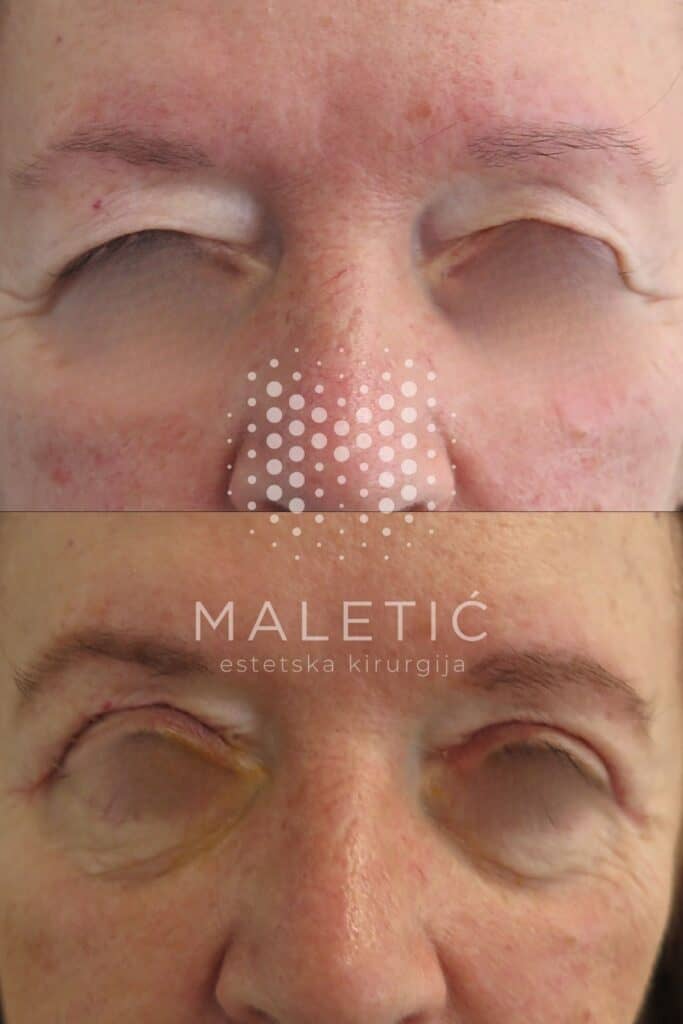
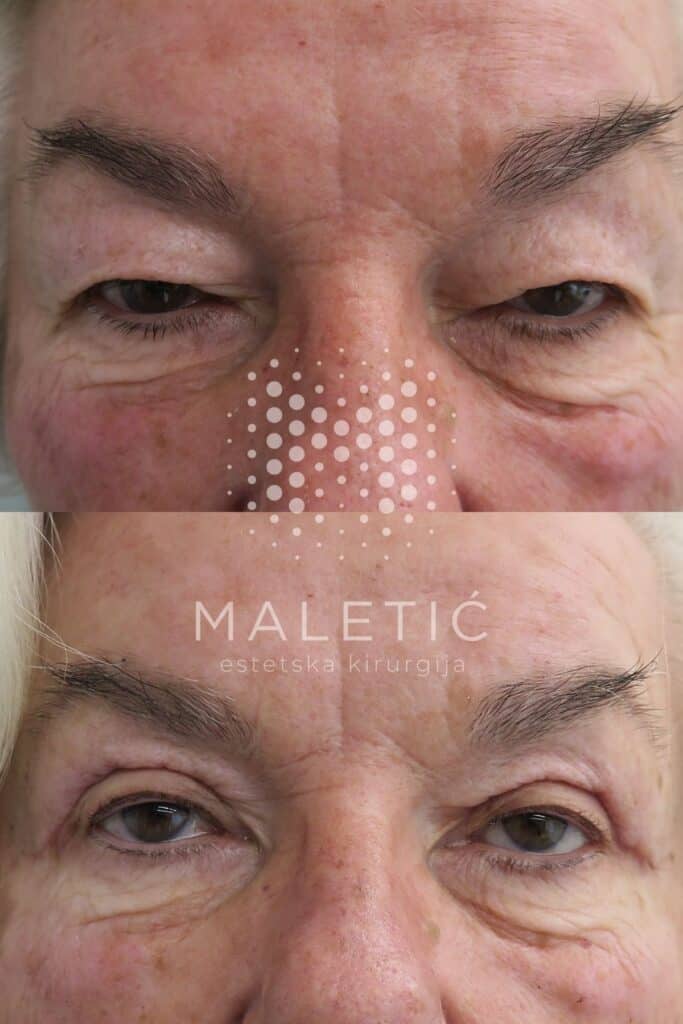
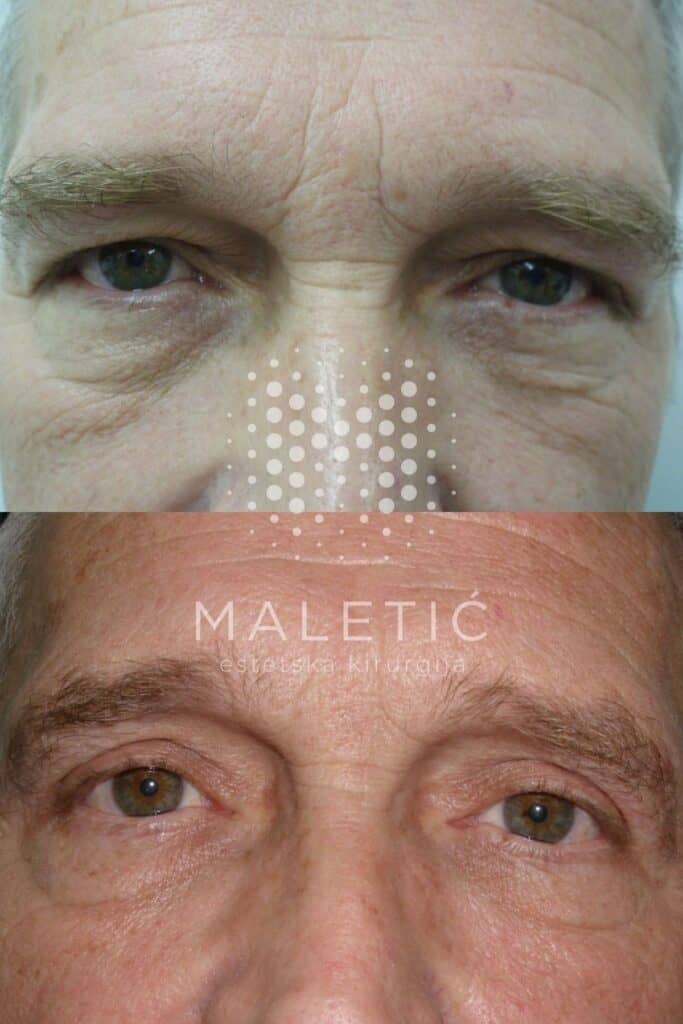
Before & after

Blepharoplasty results — patient photographs

Real photographs of Poliklinika Maletić patients — no illustrations, no retouching.

Questions & answers

Frequently asked questions about blepharoplasty

How long does blepharoplasty take?

Upper blepharoplasty takes 45–60 minutes, lower blepharoplasty 60–90 minutes. Combined upper and lower blepharoplasty in a single session takes about 2 hours.

Is blepharoplasty painful?

The procedure is performed under local anaesthesia and is completely painless. Mild discomfort may occur in the first days of recovery and is managed with painkillers.

How long do blepharoplasty results last?

The results are long-lasting — for most patients, lifelong. In some people the skin may loosen again over time, but this is individual.

When can I return to work?

Most patients return to everyday activities and office work 8–10 days after the procedure.

Will the scars be visible?

In upper blepharoplasty, the incision is hidden in the natural eyelid crease and after healing is usually only minimally visible. In lower blepharoplasty with a transconjunctival approach there is no external scar, and if the incision is made just below the lower lash line, it too is usually minimally visible.

Can I combine blepharoplasty with other procedures?

Yes. Blepharoplasty is often combined with a brow lift or facelift. The possibility of combining procedures is assessed individually during your consultation.

Do I need general anaesthesia?

The procedure is routinely performed under local anaesthesia. At the patient's request, sedation or general anaesthesia is possible — in that case an anaesthesiologist's examination and possibly additional work-up are required.

Can younger people have blepharoplasty too?

Yes. Excess eyelid skin is common in younger people as well. Age is not a barrier — what matters is the condition of the eyelids.

How much does blepharoplasty cost at Poliklinika Maletić?

Check the price of blepharoplasty in our current price list, or contact us by phone or e-mail.

The next step

Book your blepharoplasty consultation

Every procedure starts with an examination, not an assumption. At the consultation, the surgeon assesses the condition of your eyelids, discusses your wishes and gives you a concrete recommendation.